Teralo vs Procore: How Do They Compare for Construction Management?
Teralo and Procore are both cloud-based construction management platforms, but they serve different segments of the market and take different approaches to project delivery. Procore is an established US-centric platform built primarily for North American general contractors, while Teralo is a modern platform designed for international construction teams with deep support for formal correspondence, document control, and compliance workflows used across the UK, Australia, New Zealand, and the Middle East.
Platform Overview
Teralo
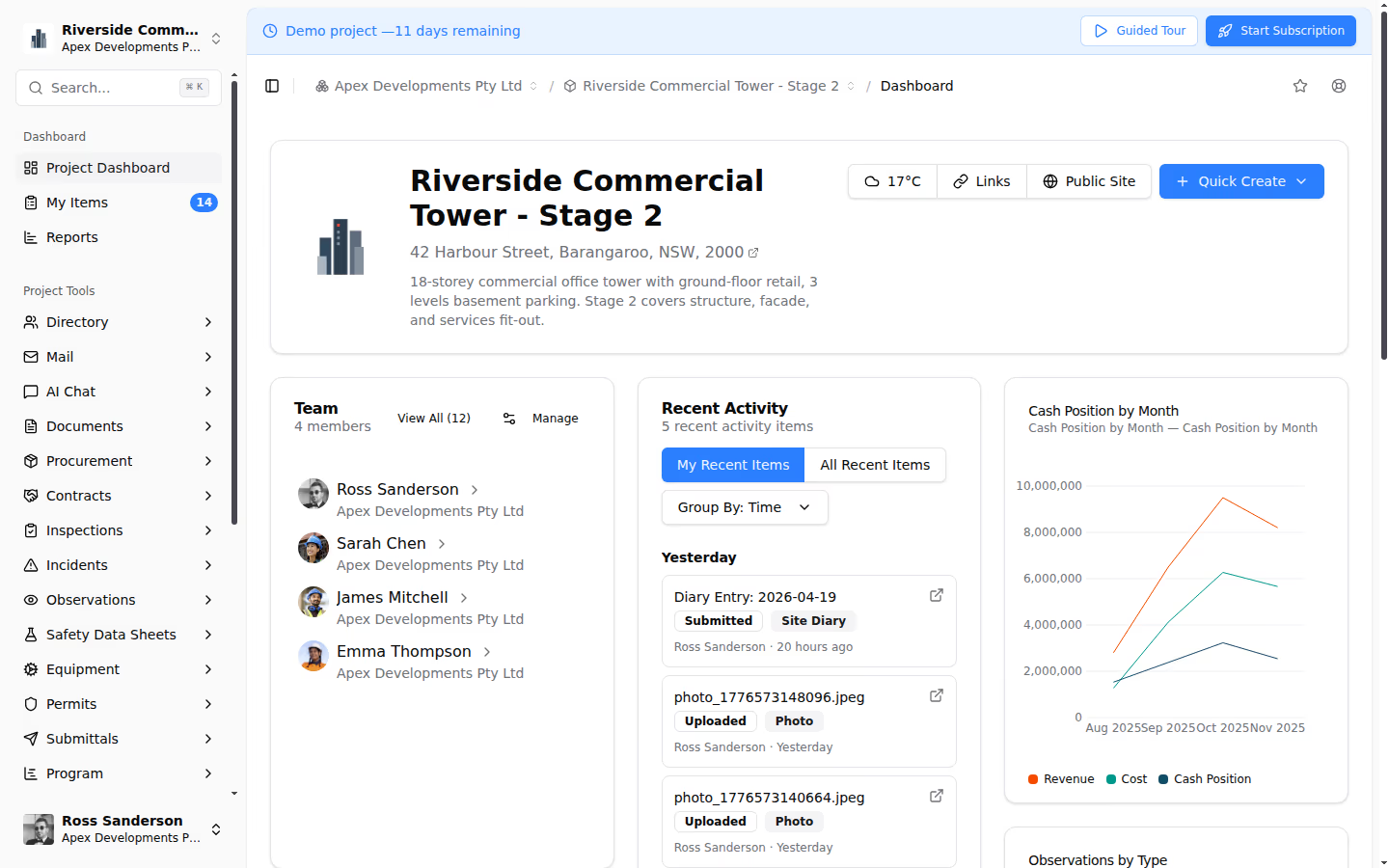
Teralo is a comprehensive construction management platform covering mail and correspondence, document control, procurement, contracts and financial management, safety and compliance, site operations, quality and submissions, and project intelligence. It is built for teams that need structured project communication, formal approval workflows, and compliance documentation as standard.
Procore
Procore is one of the largest construction management platforms in North America, offering project management, quality and safety, financial management, and workforce management tools. It has a large marketplace of integrations and a broad feature set oriented toward the US construction market.
Feature Comparison
Mail and Correspondence
Teralo provides a dedicated Mail module with configurable mail types (RFIs, site instructions, general correspondence), sequential numbering, threaded correspondence with parent-child linking, rich composition with templates and distribution groups, and formal status workflows. Every piece of correspondence is registered, numbered, and tracked through its lifecycle.
Procore handles RFIs and correspondence through its project management tools but does not have the same level of structured mail management. RFIs are a dedicated feature, but broader correspondence types like site instructions, notices, and formal letters are typically managed through email or the generic communications tool.
Verdict: Teralo's mail system is significantly more structured, which matters for projects where formal correspondence has contractual significance.
Document Management
Teralo offers a full document management system with a register-based approach, multi-format viewer (PDF with annotations, Excel, and native 3D BIM/IFC support), transmittals linked to correspondence, approval workflows, AI-powered semantic search, and split-view revision comparison.
Procore provides document management with drawing and specification management, markup tools, and version tracking. It handles drawings well but its general document management is more file-folder oriented than register-based.
Verdict: Teralo's register-based approach with transmittals and formal distribution workflows is better suited to projects requiring rigorous document control. Procore's approach is simpler but less structured.
Procurement
Teralo manages the full procurement lifecycle from package definition through tender administration, supplier evaluation, and contract award. The tender module handles bid distribution, query management, and submission tracking.
Procore offers bidding and tendering tools through its preconstruction module, with bid management, prequalification, and proposal handling. It has strong integration with estimating tools common in the US market.
Verdict: Both platforms cover procurement well, but their approaches reflect their target markets. Teralo's procurement is modelled around international tender processes, while Procore's is oriented toward US bidding conventions.
Contracts and Financial Management
Teralo provides contract management with progress claims processing, budget tracking with detailed cost breakdowns, fund transfers, variance analysis, and a financial dashboard showing contract health in real time.
Procore offers comprehensive financial tools including budgets, commitments, change orders, direct costs, invoicing, and payment applications. Its financial module is mature and well-integrated.
Verdict: Both platforms are strong in financial management. Procore has more depth in US-style payment applications, while Teralo's approach aligns better with international contract administration practices (progress claims, variations, retention management).
Safety and Compliance
Teralo provides inspections, incident management, and permits to work with configurable checklists, severity classification, investigation workflows, corrective action tracking, and a permit system with expiry management.
Procore offers quality and safety tools including inspections, observations, incidents, and action plans. It has strong mobile inspection capabilities and a large library of inspection templates.
Verdict: Comparable feature sets. Procore has a larger template library due to its larger user base. Teralo's permit-to-work system is more formally structured, reflecting its international compliance focus.
Site Operations
Teralo includes a site diary, meetings with action tracking, and bookings/scheduling, tools specifically designed for daily site management.
Procore offers daily logs and meeting management but does not have a dedicated resource booking system comparable to Teralo's.
Verdict: Teralo offers more comprehensive day-to-day site operations tools, particularly the resource booking system.
Intelligence and Reporting
Teralo provides a configurable project dashboard with KPI cards, AI chat for natural language project queries, and custom reports with export to PDF, Excel, or CSV.
Procore offers analytics and reporting through its core platform and the Procore Analytics add-on, with customisable dashboards and reporting capabilities.
Verdict: Both platforms offer project intelligence, but Teralo's AI chat capability for natural language project queries is a differentiating feature.
Pricing and Accessibility
Teralo is priced per organisation on annual construction volume, tailored to the kind of organisation you are: a developer is priced differently from a head contractor of the same size. Every module is included, there are no per-seat fees, and everyone a host invites onto its projects (subcontractors, consultants, suppliers and clients) uses Teralo free.
Procore also prices on annual construction volume. It is generally considered a premium-priced platform, with pricing that scales with project volume.
Who Should Choose Which?
Choose Teralo if:
- You operate in international markets (UK, Australia, NZ, Middle East, or multi-region)
- Formal correspondence management is contractually important
- You need structured document control with transmittals and approval workflows
- You need a permit-to-work system integrated with your safety management
- You want an all-in-one platform without per-module add-on costs
Choose Procore if:
- You operate primarily in the North American market
- You need deep integrations with US-specific tools (estimating, accounting, ERP)
- You have a large workforce and need Procore's workforce management tools
- You are already invested in the Procore ecosystem and marketplace
Conclusion
Both Teralo and Procore are capable construction management platforms. The right choice depends on your market, your project requirements, and how important structured correspondence and document control are to your operations. For international teams that need formal, auditable project management workflows, Teralo provides the depth and structure that modern construction projects demand.