Teralo vs Aconex: How Does Document Management Compare?
Teralo and Aconex (now Oracle Aconex) are both used for construction document management, but they represent different generations of construction technology. Aconex was a pioneering project collaboration platform, while Teralo is a modern, all-in-one construction management platform that includes document management alongside nine other integrated modules. The comparison matters because many teams currently using Aconex are evaluating alternatives as Oracle's product direction evolves.
Platform Overview
Teralo
Teralo is a comprehensive construction management platform that covers the full project lifecycle: mail and correspondence, document control, procurement, contracts, safety, site operations, quality, and intelligence. Document management is one module within a tightly integrated system.
Aconex
Aconex was one of the first cloud-based construction collaboration platforms, founded in Australia in 2000 and acquired by Oracle in 2018. It is primarily a document management and project correspondence platform, with strengths in controlled document distribution, mail (correspondence), and workflow management. Since the Oracle acquisition, it has been positioned within Oracle's broader construction and engineering cloud.
Document Management Comparison
Document Register
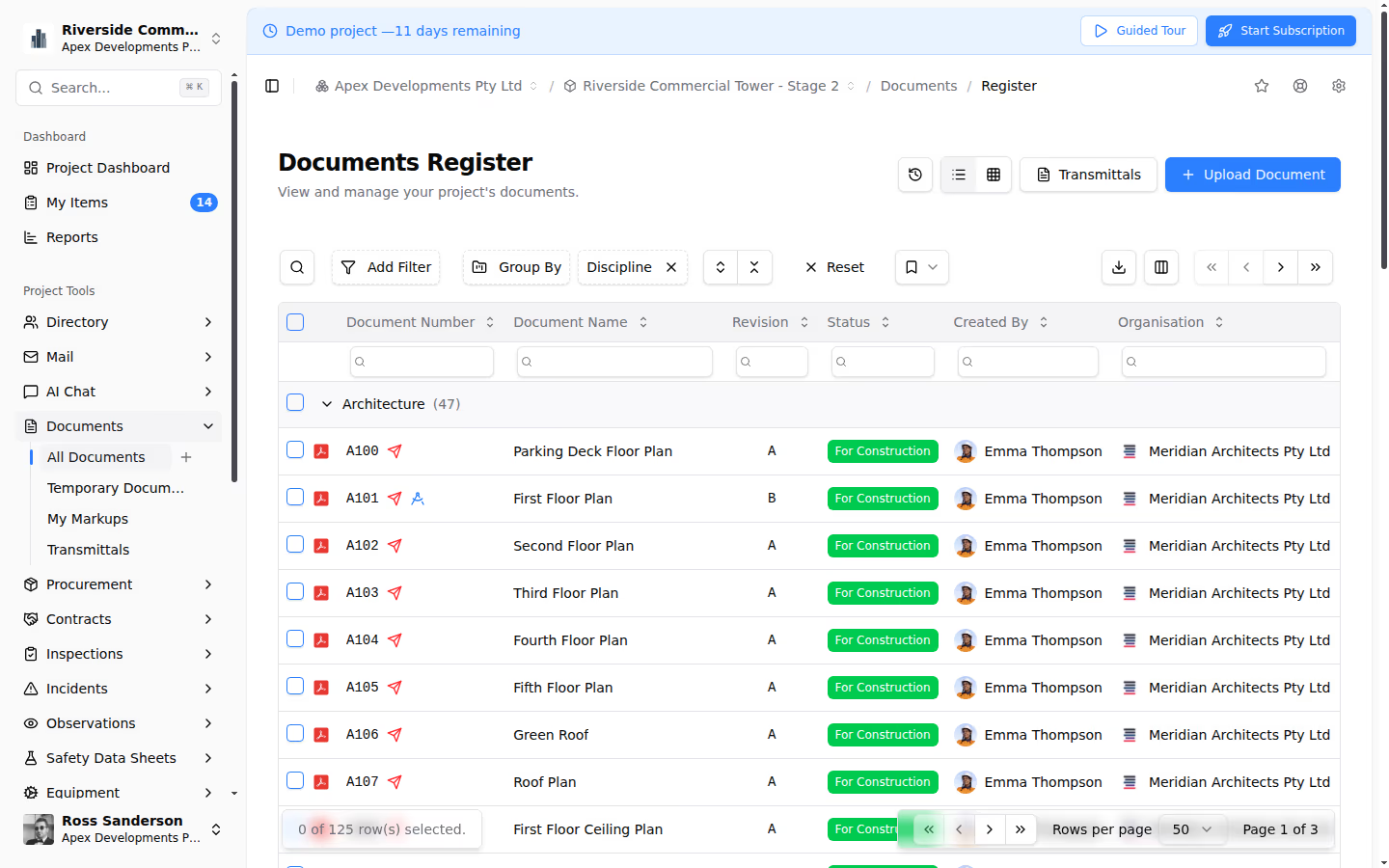
Teralo provides a register-based document management system with rich metadata, full revision history, and customisable fields. Documents are organised in a structured register with filtering, sorting, and search capabilities. The register approach ensures every document has a defined number, status, and revision.
Aconex also uses a register-based approach and was one of the first platforms to implement this model for construction. Its document register is mature and well-understood by teams who have used it on previous projects.
Verdict: Both platforms use the register model effectively. Aconex has a longer history with this approach, while Teralo provides a more modern interface.
Document Viewer
Teralo includes a multi-format viewer supporting PDFs with annotations, Excel workbooks, and native 3D BIM/IFC models. The split-view feature allows side-by-side comparison between document revisions, which is critical for identifying changes between drawing issues.
Aconex provides a document viewer for PDFs with markup capabilities. Its viewer is functional but predates some modern features like native BIM viewing and side-by-side revision comparison.
Verdict: Teralo's viewer is more capable, particularly for BIM models and revision comparison.
Transmittals
Teralo links transmittals to the mail and correspondence system, creating a formal record of document distribution that integrates with project correspondence. Each transmittal records what was sent, to whom, and for what purpose.
Aconex has strong transmittal capabilities, as it was built around the concept of controlled document distribution. Transmittals in Aconex are a core feature with detailed tracking and audit trails.
Verdict: Both platforms handle transmittals well. Aconex's transmittal system is mature and widely used. Teralo's integration with its mail module provides a tighter correspondence-to-document link.
Approval Workflows
Teralo provides configurable approval workflows with sequential or parallel review steps, role-based routing, and configurable response options (approve, reject, approve with comments).
Aconex offers workflow management with configurable review and approval processes. Its workflow engine is well-established and handles complex multi-party review scenarios.
Verdict: Comparable capabilities. Both platforms support the structured approval workflows that construction document control requires.
Search and AI
Teralo includes AI-powered semantic search that finds documents by meaning rather than just filename or metadata, plus auto-categorisation that reduces manual document classification effort.
Aconex provides standard search capabilities based on metadata and full-text indexing. Oracle has been introducing AI features across its cloud products, but Aconex-specific AI capabilities are evolving.
Verdict: Teralo's AI-powered search is a genuine differentiator for teams managing large document libraries.
Correspondence Comparison
Mail Management
Teralo offers a dedicated Mail module with configurable mail types, sequential numbering, threaded correspondence, rich text composition, templates, distribution groups, and status workflows. It is designed as a complete formal correspondence system.
Aconex was one of the first platforms to implement structured project mail with numbered correspondence, distribution tracking, and audit trails. Its mail system is a core strength.
Verdict: Both platforms take correspondence management seriously. Teralo's configurable mail types and threading provide flexibility, while Aconex's mail system has decades of refinement.
Beyond Document Management
The most significant difference between Teralo and Aconex is scope:
Teralo is an all-in-one platform. Beyond documents and correspondence, it includes:
- Procurement: package management, tender administration, supplier coordination
- Contracts: progress claims, budget tracking, financial dashboards
- Safety: inspections, incidents, permits to work
- Site Operations: site diary, meetings, bookings
- Quality: submittals, method statements, inductions
- Intelligence: dashboards, AI chat, reports
Aconex focuses primarily on document management and correspondence. For other construction management functions, Oracle offers separate products (Primavera for scheduling, Textura for payment management, etc.) or relies on third-party integrations.
Verdict: If you need document management only, both platforms are capable. If you need a comprehensive construction management platform, Teralo provides a single integrated system versus Aconex's document-centric approach requiring additional tools for other functions.
Migration Considerations
Teams considering a move from Aconex to Teralo should consider:
- Data migration: document registers, correspondence history, and metadata can be migrated to Teralo
- User training: both platforms use similar concepts (registers, transmittals, workflows) so the learning curve is manageable
- Integration changes: any integrations with Aconex will need to be re-evaluated
- Cost structure: compare total cost of ownership including all modules you need, not just document management
Who Should Choose Which?
Choose Teralo if:
- You want a single platform covering documents, correspondence, procurement, contracts, safety, site ops, quality, and intelligence
- You value AI-powered search and modern document viewing capabilities
- You want one agreement that covers every module, with invited organisations free
- You are starting a new project and want to consolidate your technology stack
Choose Aconex if:
- You are on an existing project already using Aconex with established processes
- You are contractually required to use Aconex by the client or project requirements
- You operate within the broader Oracle ecosystem and need deep integration with Primavera, Textura, or other Oracle products
- Your primary need is document management and correspondence only
Conclusion
Both Teralo and Aconex are capable document management platforms for construction. The decision comes down to whether you need a focused document management tool (Aconex) or a comprehensive construction management platform that includes excellent document management alongside a full suite of project delivery tools (Teralo).