How Are Method Statements Treated Across Different Countries?
Method statements are treated differently across countries, but the core purpose remains the same everywhere: documenting how construction work will be carried out safely and to the required quality standard. The terminology, legal requirements, and level of enforcement vary significantly between the UK, Australia, New Zealand, the United States, and the Middle East.
United Kingdom
Terminology and Framework
In the UK, method statements are commonly called method statements or safe systems of work. They are closely linked to risk assessments and together form the core of the RAMS (Risk Assessment and Method Statement) documentation that is standard on virtually every UK construction project.
Legal Requirements
Method statements are not explicitly mandated by a single piece of legislation, but they are effectively required through several overlapping regulations:
- The Construction (Design and Management) Regulations 2015 (CDM 2015) require principal contractors to plan, manage, and monitor construction work and ensure suitable arrangements for managing risk. Method statements are the primary mechanism for demonstrating this planning.
- The Health and Safety at Work Act 1974 places a general duty on employers to ensure safe systems of work. Method statements document these systems.
- The Management of Health and Safety at Work Regulations 1999 require employers to make suitable and sufficient risk assessments. Method statements describe the controls arising from those assessments.
Common Practice
On UK construction sites, it is standard practice for subcontractors to submit RAMS for every significant work activity before starting on site. The principal contractor reviews and approves these documents. High-risk activities like working at height, hot works, and confined space entry typically require more detailed method statements and may be linked to a permit-to-work system.
Australia
Terminology and Framework
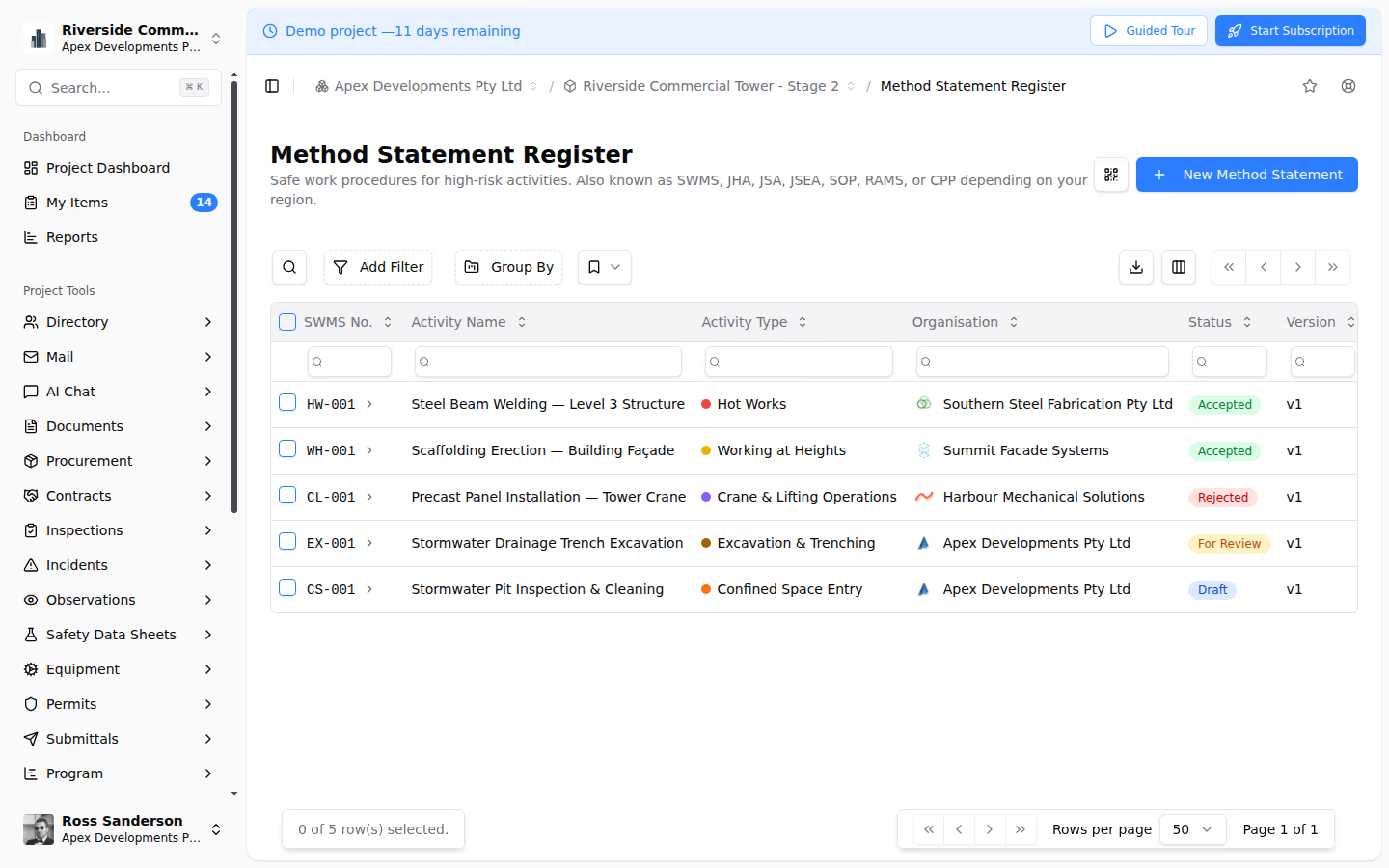
Australia uses the term Safe Work Method Statement (SWMS), which is more prescriptive than the UK equivalent. The SWMS is specifically defined in workplace health and safety legislation and has a clear legal status.
Legal Requirements
- The Work Health and Safety Act 2011 (WHS Act) and Work Health and Safety Regulations 2011 apply in most Australian states and territories (with some variations in Western Australia and Victoria).
- SWMS are legally required for all high-risk construction work (HRCW) as defined in the regulations. High-risk construction work includes work at height above 2 metres, work in trenches deeper than 1.5 metres, demolition, work near traffic, and many other activities.
- A person conducting a business or undertaking (PCBU) must ensure a SWMS is prepared before high-risk construction work commences.
- Workers must be consulted during the preparation of the SWMS.
Common Practice
SWMS are taken very seriously on Australian construction sites. Regulators like SafeWork NSW, WorkSafe Victoria, and Workplace Health and Safety Queensland actively audit SWMS during site inspections. A missing or inadequate SWMS for high-risk work can result in improvement notices, prohibition notices, or prosecution.
Workers are typically required to sign onto the SWMS before commencing the relevant task, acknowledging they have read and understood the safe work procedure.
New Zealand
Terminology and Framework
New Zealand follows a similar model to Australia, using the term safe work method statement or simply method statement. The regulatory framework is closely aligned with the Australian model following New Zealand's adoption of harmonised workplace health and safety legislation.
Legal Requirements
- The Health and Safety at Work Act 2015 (HSWA) and Health and Safety at Work (General Risk and Workplace Management) Regulations 2016 require PCBUs to manage risks and ensure safe systems of work.
- While SWMS are not as rigidly mandated for a defined list of high-risk activities as in Australia, WorkSafe New Zealand expects documented safe work procedures for all significant construction activities.
- Particular hazardous work defined in the regulations requires additional controls and documentation.
Common Practice
In practice, New Zealand construction sites follow a very similar approach to Australia. SWMS or equivalent documents are standard for any work activity involving significant risk. The main difference is that New Zealand's regulatory framework is slightly less prescriptive about which specific activities require formal SWMS, giving PCBUs more discretion, but also more responsibility, in determining what documentation is needed.
United States
Terminology and Framework
The United States does not have a single equivalent to the method statement. Instead, safety documentation takes several forms depending on the context:
- Job Hazard Analysis (JHA) or Job Safety Analysis (JSA): the closest equivalent, breaking a task into steps, identifying hazards at each step, and defining controls
- Activity Hazard Analysis (AHA): used on US Army Corps of Engineers projects and increasingly adopted industry-wide
- Standard Operating Procedures (SOPs): for routine activities
- Work plans: broader documents covering how work will be executed
Legal Requirements
- OSHA (Occupational Safety and Health Administration) does not mandate method statements by name, but its regulations require employers to identify and address workplace hazards. JHAs/JSAs are the accepted mechanism.
- 29 CFR 1926 (OSHA Construction Standards) contain specific requirements for fall protection plans, crane lift plans, confined space procedures, and other high-risk activities that function as specialised method statements.
- The US Army Corps of Engineers EM 385-1-1 requires Activity Hazard Analyses for all construction activities on Corps projects, which is the most prescriptive federal requirement.
Common Practice
Practice varies widely across the US construction industry. Large general contractors and federally funded projects typically require comprehensive JHAs/AHAs. Smaller private-sector projects may have less formal documentation. The lack of a standardised national requirement means quality and consistency vary more than in the UK, Australia, or New Zealand.
Middle East
Terminology and Framework
Middle East construction markets, particularly the UAE, Saudi Arabia, Qatar, and Oman, generally use the term method statement and follow frameworks heavily influenced by British practice due to historical engineering ties and the prevalence of UK-trained consultants and contractors.
Legal Requirements
Requirements vary by country:
- UAE: Municipalities (e.g., Dubai Municipality, Abu Dhabi Municipality) require method statements for construction activities. The UAE Fire and Life Safety Code and various emirate-level regulations reference method statement requirements.
- Saudi Arabia: Saudi Aramco projects follow their own stringent safety requirements that include detailed method statements. The Saudi Building Code and General Authority for Meteorology and Environmental Protection (GAMEP) requirements apply more broadly.
- Qatar: Following the 2022 FIFA World Cup construction programme, Qatar significantly strengthened its construction safety regulations. Method statements are required for all significant activities.
- Oman: The Oman Construction Industry guidelines require method statements for high-risk activities.
Common Practice
Method statements in the Middle East tend to be very detailed documents, often running to dozens of pages for complex activities. This reflects both the influence of UK practice and the high-risk nature of construction in extreme heat conditions. Heat stress management, dust control, and Ramadan working-hour adjustments are commonly included in Middle Eastern method statements.
International contractors operating in the region typically apply whichever standard is more stringent: their home country requirements or local regulations.
How Teralo Supports Global Method Statement Requirements
Teralo's Quality & Submissions module is designed to accommodate the varying method statement requirements across different jurisdictions:
- Flexible templates that can be configured for RAMS (UK), SWMS (Australia/NZ), JHA/AHA (US), or local formats (Middle East)
- Approval workflows that match the review chain required by local regulations, from simple approve/reject to multi-stage parallel reviews
- Digital acknowledgement where workers can sign onto method statements electronically, meeting the Australian SWMS sign-on requirement
- Version control to maintain full revision history as required by all jurisdictions
- Audit trails that demonstrate regulatory compliance during inspections regardless of which country's framework applies
Conclusion
While the name and legal framework differ across countries, the fundamental requirement is universal: construction work must be planned, documented, and communicated to the people performing it. A digital platform like Teralo enables teams working across multiple jurisdictions to meet all local requirements using a single, consistent system.