How Does Teralo Contracts Handle Construction Financial Management?
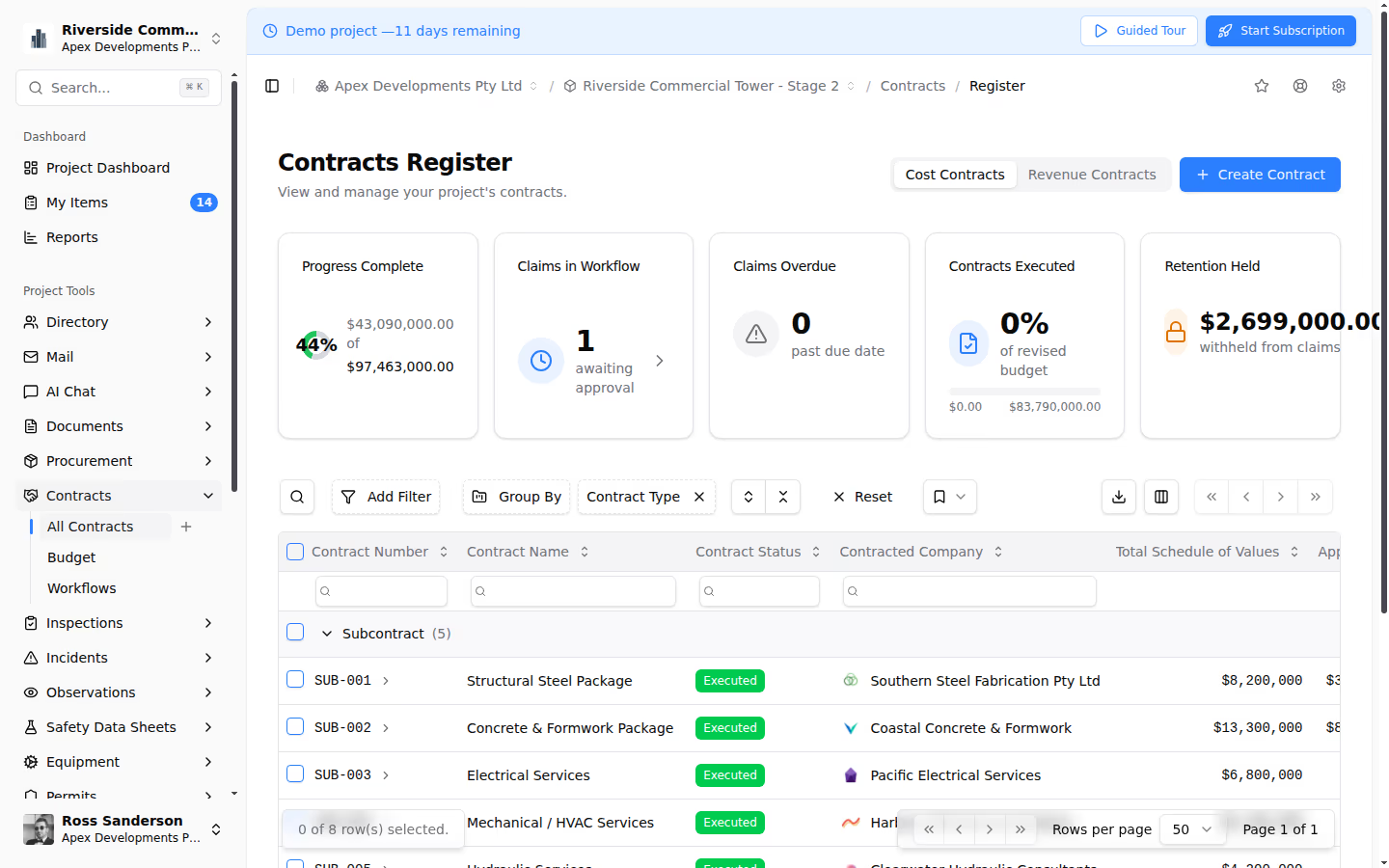
Teralo Contracts handles construction financial management by providing integrated tools for progress claims processing, budget tracking with detailed cost breakdowns, variation management, and financial dashboards that show contract health in real time. It replaces spreadsheet-based financial administration with a structured system where every claim, variation, and budget movement is tracked and auditable.
Why Construction Financial Management Is Complex
Construction contracts are financially complex because:
- Multiple concurrent contracts: a project may have 20-50 subcontracts plus the head contract, each with its own payment terms, schedules, and retention rules
- Monthly claim cycles: every contract has a monthly progress claim that must be submitted, reviewed, and certified within contractual timeframes
- Variations accumulate: scope changes modify contract values throughout the project, each requiring individual assessment and approval
- Retention management: a percentage of each payment is withheld as security, released in stages at practical completion and defects liability expiry
- Budget tracking: original budgets must be tracked against committed costs, actual expenditure, and forecast final costs
Managing all of this in spreadsheets is the norm on many projects, but it creates:
- Version control problems (which spreadsheet is current?)
- Formula errors (undetected mistakes in complex calculations)
- No audit trail (who changed what and when?)
- Limited visibility (only the person with the spreadsheet knows the financial status)
- Reconciliation nightmares (matching claims, certificates, and payments across multiple spreadsheets)
How Teralo Contracts Works
Progress Claims
Teralo's progress claim system handles the monthly payment cycle:
Schedule of values: Each contract has a schedule of values: a line-by-line breakdown of the contract scope with quantities and rates. Claims are assessed against this schedule, with each line item showing the claimed percentage or amount for the current period.
Claim submission: Contractors submit their progress claim through Teralo with the schedule breakdown, supporting documentation, and any relevant photographs or measurement records.
Multi-step review: Claims route through the approval workflow:
- Contractor submits the claim
- Superintendent/consultant assesses the claim, adjusting quantities or values where necessary
- Adjustments are communicated to the contractor
- Payment certificate is issued with the assessed amount
- Client finance processes payment
Each step is tracked with dates, so contractual payment timeframes are visible. If a claim has been under review for 20 days against a 28-day contractual assessment period, the system shows the urgency.
Retention calculation: Retention is calculated automatically based on the contract terms, typically a percentage of each claim up to a defined limit, with release milestones at practical completion and defects liability expiry.
Cumulative tracking: The system shows cumulative progress at every point: total contract value, total claimed to date, total certified to date, total paid to date, and retention held. This eliminates the reconciliation problems that plague spreadsheet-based management.
Budget Tracking
Budget management in Teralo provides financial visibility across all contracts:
Cost breakdown: Budgets are structured with detailed cost categories and line items. Each category shows the original budget, approved variations, revised budget, committed costs, actual expenditure, and forecast final cost.
Fund transfers: When budget needs to move between categories (e.g., savings in structural steel funding additional architectural features), fund transfers are tracked as discrete transactions with approval, maintaining a clear audit trail of every budget change.
Variance analysis: Compare budgets against actual costs at every level of detail, from the project total down to individual cost lines. Variances are highlighted automatically, drawing attention to categories that are over or under budget.
Variation Management
Variations are tracked in a central register:
Status tracking: Each variation progresses through defined stages: identified, contractor quotation received, assessed, approved, rejected, or incorporated into the contract. The register shows the status of every variation at a glance.
Value tracking: Variations show the contractor's claimed value, the assessed value, and the approved value. The difference between claimed and approved is a measure of commercial dispute on the project.
Contract value updates: Approved variations automatically update the contract value, the schedule of values, and the budget. There is no manual reconciliation between the variation register and the contract value.
Documentation links: Each variation links to its supporting documentation: the instruction or event that triggered it, the contractor's quotation, the consultant's assessment, correspondence about the variation, and the approval record.
Financial Dashboard
The financial dashboard provides real-time visibility into contract health:
- Contract summary: original value, approved variations, revised value, claimed, certified, paid, retention
- Cash flow: monthly claims and payments over the project timeline
- Variation exposure: total value of variations by status (approved, under assessment, disputed)
- Budget health: variance analysis at summary and detailed levels
- Claims status: which contracts have claims due, under review, or overdue for certification
- Retention schedule: when retention will be released based on milestone dates
Integration with Procurement
When a tender is awarded through Teralo Procurement, the contract record is created automatically:
- The awarded value becomes the contract budget
- The tendered schedule of values becomes the basis for progress claims
- The scope documentation from the tender links to the contract record
- The supplier's details carry forward from the supplier database
This eliminates the data re-entry and information loss that occurs when procurement and contracts are managed in separate systems.
Integration with Other Modules
- Documents: contract documents, variations, and claims reference drawings and specifications in the document register
- Mail: contractual correspondence (notices, instructions, claims) links to the mail register
- Intelligence: financial KPIs feed into the project dashboard, and contract data is queryable through AI Chat
Conclusion
Teralo Contracts provides structured financial management for construction projects, from monthly progress claims through budget tracking, variation management, and real-time financial dashboards. It replaces the spreadsheet-based approach that creates errors, limits visibility, and complicates audits with an integrated system where every financial transaction is tracked, approved, and visible to the project team.