What Is Construction Document Control and Why Does It Matter?
Construction document control is the systematic process of managing, tracking, and distributing project documents (including drawings, specifications, contracts, transmittals, and correspondence) to ensure that every team member works from the correct, most current version. Poor document control is one of the leading causes of rework, disputes, and cost overruns on construction projects.
Why Document Control Matters
A typical construction project generates thousands of documents over its lifecycle. Design drawings alone can run into hundreds of sheets, each going through multiple revisions. Add specifications, contracts, submittals, RFIs, meeting minutes, inspection reports, and correspondence, and the volume becomes enormous.
When document control fails, the consequences are severe:
- Construction from superseded drawings: the most common and costly failure, leading to rework that can cost hundreds of thousands of dollars
- Missed design changes: critical revisions that do not reach the site team
- Contractual disputes: inability to prove which version of a document was current at a given date
- Audit failures: regulators or clients finding that required documentation is incomplete or uncontrolled
- Knowledge loss: when project handover documentation is incomplete, the building operator inherits an information gap
Core Principles of Document Control
Single Source of Truth
Every document must have one authoritative location. Whether it is a drawing register, a document management system, or a project extranet, every team member must know where to find the current version of any document. Duplicate copies stored on local drives, email attachments, and USB sticks are the enemy of document control.
Revision Management
Every document must carry a clear revision identifier (e.g., Rev A, Rev B, Rev 01, Rev 02) and a revision date. The system must make it obvious which version is current and provide access to previous versions for audit purposes. Superseded versions should be clearly marked but not deleted.
Controlled Distribution
Documents must be distributed through a formal process (typically a transmittal) that records what was sent, to whom, when, and for what purpose (e.g., for information, for review, for construction). This creates an auditable trail that demonstrates the information was made available to the relevant parties.
Status Workflows
Documents move through defined statuses as they progress through review and approval:
- Draft: under preparation, not yet suitable for use
- For Review: issued for comment or review by stakeholders
- For Construction: approved for use on site
- As Built: reflects the final constructed condition
- Superseded: replaced by a newer revision
Metadata and Classification
Documents must be tagged with consistent metadata to enable searching and filtering:
- Document number and title
- Discipline (architectural, structural, mechanical, electrical, etc.)
- Zone or area of the project
- Originator (which company produced it)
- Revision number and date
- Current status
Document Types in Construction
Drawings
The largest category by volume. Includes architectural, structural, civil, mechanical, electrical, hydraulic, fire services, and landscape drawings. Each discipline may produce hundreds of sheets across multiple revision cycles.
Specifications
Technical documents defining materials, workmanship standards, testing requirements, and quality criteria. Usually organised by trade or work section (e.g., concrete, steelwork, waterproofing).
Contracts and Commercial Documents
Including the head contract, subcontracts, variations, progress claims, and financial reports. These require strict access control as they contain commercially sensitive information.
Submittals
Documents submitted by contractors and subcontractors for approval: material samples, shop drawings, product data sheets, method statements, and test certificates.
Correspondence
Formal project correspondence including RFIs (Requests for Information), site instructions, notices, and general correspondence. Each type typically has its own numbering sequence and tracking requirements.
Reports
Inspection reports, test results, commissioning records, safety reports, and progress reports that document the project's execution and compliance.
How Teralo Manages Document Control
Teralo's Documents module provides a complete document management system built specifically for construction projects.
Document Register and Viewer
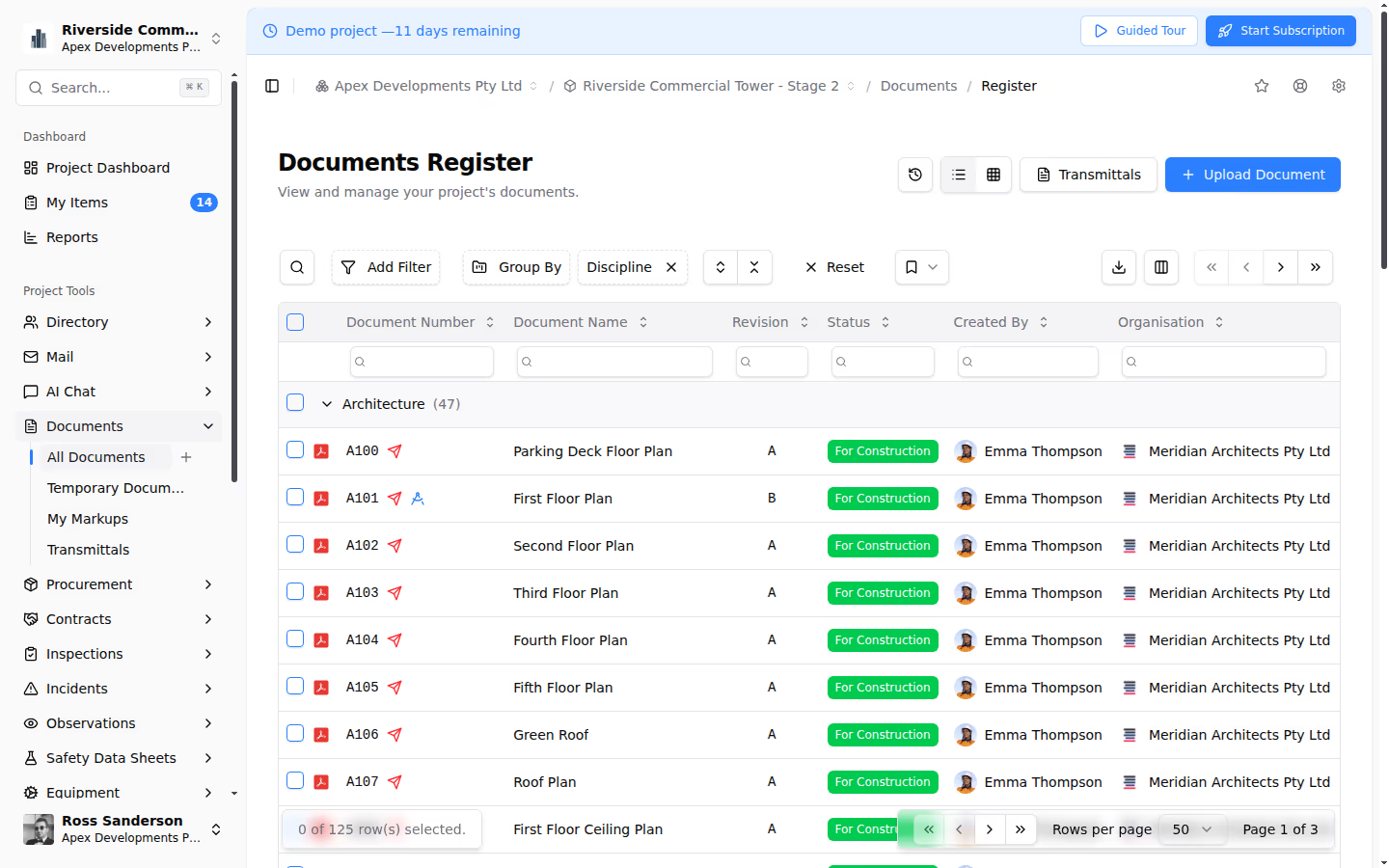
Teralo maintains a centralised document register with rich metadata, full revision history, and a multi-format viewer that handles PDFs with annotations, Excel workbooks, and native 3D BIM/IFC models. The split-view feature allows side-by-side comparison between document revisions, which is essential for identifying changes between drawing issues.
Transmittals and Workflows
Documents are distributed through formal transmittals that are linked to correspondence records. Each transmittal records the documents sent, recipients, purpose, and any covering notes. Approval workflows route documents through sequential or parallel review steps with configurable reviewers and approval criteria.
AI-Powered Upload and Search
Teralo's drag-and-drop upload includes a staging area for bulk registration, allowing teams to upload dozens of documents and tag them with metadata before committing to the register. AI-powered semantic search lets users find documents by meaning rather than just filename or number, and auto-categorisation reduces the manual effort of document classification.
Access Control
Sensitive documents can be restricted to specific user roles or organisations. Commercial documents, for example, can be limited to the client's commercial team and the contractor's quantity surveyors.
Best Practices for Construction Document Control
- Establish naming conventions early: agree on document numbering, file naming, and revision schemes before the first document is issued
- Define the distribution matrix: document who needs to receive which types of documents and at what stages
- Use transmittals for every formal issue: never rely on email attachments for controlled documents
- Audit regularly: check that the register matches what is actually being used on site
- Train all participants: document control only works if everyone follows the process, including subcontractors
- Archive comprehensively: at project completion, ensure the complete document record is archived for the building lifecycle
Conclusion
Document control is not administrative overhead; it is a critical project management function that prevents rework, protects contractual positions, and ensures regulatory compliance. A purpose-built platform like Teralo makes document control systematic, searchable, and auditable across the entire project team.